A 128 Hz tuning fork tests vibration sense in the neurological examination, for example when screening for peripheral neuropathy. A 512 Hz tuning fork is for the Rinne and Weber hearing tests. They are not interchangeable, so most medical, nursing and physiotherapy students end up needing both: one for the peripheral neuro exam and one for the ear.
The short answer
- 128 Hz: felt strongly, so it is the fork for vibration sense.
- 512 Hz: heard clearly and felt less, so it is the fork for Rinne and Weber.
- Interpret Rinne and Weber together, never alone.
- Most students need one of each; the Neuro & ENT Exam Kit has both.
What is a tuning fork used for?
Struck, a tuning fork vibrates at a fixed frequency. Placed on bone, the patient feels that vibration, which tests the large sensory fibres and dorsal columns. Held near the ear or on the skull, the patient hears it, which lets you compare air conduction with bone conduction and tell a conductive hearing loss from a sensorineural one.
Which job a fork does well depends on its frequency. Low frequencies are felt strongly and buzz for a long time, which suits vibration testing. Higher frequencies are heard more than felt, which suits hearing tests.
| 128 Hz | 512 Hz | |
|---|---|---|
| Main use | Vibration sense (neurological examination) | Rinne and Weber tests (hearing) |
| Where it goes | Bony prominences: big toe, finger joints, ankle, wrist | Mastoid process, beside the ear canal, forehead or vertex |
| What the patient reports | A buzzing they can feel, and when it stops | A tone they can hear, and where or how loud |
| Examination | Peripheral neuro exam, diabetic foot screening | Ear and cranial nerve VIII examination |
How to test vibration sense with a 128 Hz fork
Vibration sense, step by step
Strike the fork
Against the heel of your hand or your knee, not a hard surface.
Show the patient what to expect
Place the base on the sternum first so they know what the buzzing feels like.
Test distally, eyes closed
Place the base on the distal interphalangeal joint of the big toe, or the tip of a finger in the upper limb.
Ask when it stops
Ask whether they can feel it buzzing and to tell you when it stops. Damp the tines with your fingers to check they are not guessing.
Move proximally if absent
Medial malleolus, tibial tuberosity, then anterior superior iliac spine; in the arm, wrist, elbow, then shoulder. Compare both sides.
Loss that starts distally and moves up is the pattern you look for in a length-dependent peripheral neuropathy, such as in diabetes.
How to do the Rinne and Weber tests with a 512 Hz fork
Rinne test
Bone conduction
Strike the 512 Hz fork and place the base firmly on the mastoid process behind the ear.
Air conduction
When the patient can no longer hear it, move the tines about 2 cm from the ear canal and ask whether they can hear it again.
Or compare loudness
Alternatively, ask which is louder: on the mastoid or beside the ear.
Normally air conduction is better than bone conduction (Rinne positive). In a conductive loss in that ear, bone conduction is better (Rinne negative). In a sensorineural loss, air conduction stays better than bone, because both are reduced.
Weber test
Midline placement
Strike the fork and place the base in the midline: the forehead, vertex or bridge of the nose.
Ask where they hear it
In the middle, or louder in one ear?
Normally it is heard in the middle. In a conductive loss it lateralises to the affected ear; in a sensorineural loss it lateralises to the better ear.
| Finding | Rinne (affected ear) | Weber |
|---|---|---|
| Normal hearing | Air better than bone | Central |
| Conductive loss | Bone better than air | Lateralises to the affected ear |
| Sensorineural loss | Air better than bone | Lateralises to the better ear |
Why not use one fork for both?
A 128 Hz fork is felt as much as it is heard. Held on the mastoid, the patient may report the vibration rather than the sound, which muddies a hearing test. A 512 Hz fork is heard clearly but felt less, so it is a poor test of vibration sense. That is why standard teaching uses 128 Hz for the neuro exam and 512 Hz for the ear, and why an OSCE examiner may ask which fork you would choose.
Higher frequencies exist too. The WiZmed fork is also available at 1024 Hz, for testing higher frequencies by air conduction, and ADC makes forks from 128 Hz to 4096 Hz. For a student, 128 Hz and 512 Hz cover the bedside examinations.
Which tuning fork should medical students buy?
Buy one 128 Hz and one 512 Hz. Your choice is mostly between two makes.
WiZmed vs ADC tuning forks
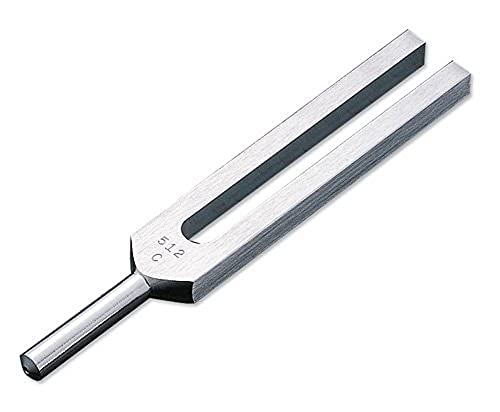 Student pick WiZmed Tuning ForkFrom R259 | 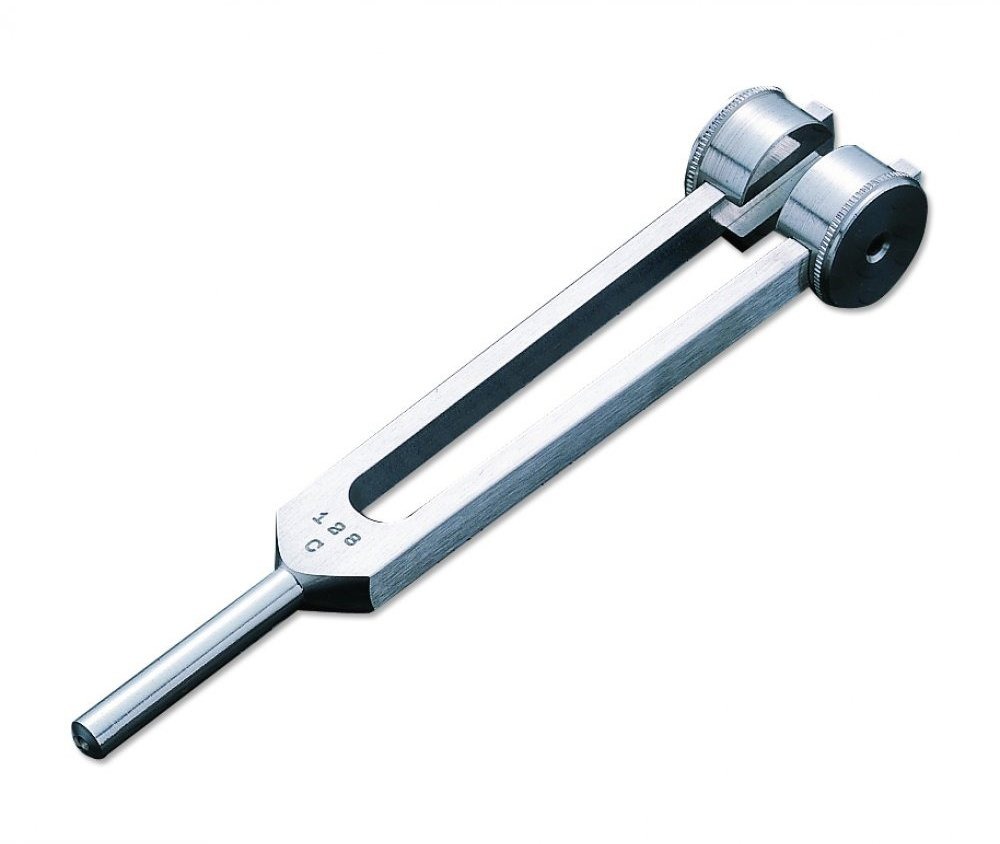 From R379 | |
|---|---|---|
| Frequencies | 128 Hz, weighted 128 Hz, 512 Hz, 1024 Hz | 128, 256, 512, 1024, 2048 and 4096 Hz |
| Material | Non-magnetic aluminium alloy | Non-magnetic aluminium alloy, satin finish |
| Handle | Standard | 5 cm handle for bone conduction tests |
| Price tier | Entry-level | Mid-range |
Our verdict
The WiZmed fork covers everything a student is examined on for less. The ADC fork adds the longer handle and a wider range of frequencies, which suits someone who will keep using it.
Or get both forks in a kit
Physiotherapy and OT students who only need vibration sense can take the Physio & Rehab Assessment Kit, which has a 128 Hz fork with two goniometers, a hammer and measuring tapes. For sensation testing alongside the forks, the Buck hammer has a built-in brush and needle. Before the Rinne test, an otoscope such as the Welch Allyn Pocket Junior lets you check the ear canal.
Pairs well with



Looking after a tuning fork
- Hold it by the stem, never the tines; touching them damps the vibration.
- Strike it on something firm but soft, such as your palm, knee or a rubber pad. Banging it on a desk can damage it and adds overtones.
- Wipe the base between patients, as you would a stethoscope diaphragm.
For the rest of the kit you will need on the ward, see our medical student equipment list.
Questions people ask
What is the difference between a 128 Hz and a 512 Hz tuning fork?
The 128 Hz fork is for vibration sense in the neurological examination; its low frequency is felt strongly. The 512 Hz fork is for the Rinne and Weber hearing tests; it is heard clearly and felt less, so the patient reports sound rather than vibration.
Which tuning fork is used for the Rinne and Weber tests?
The 512 Hz tuning fork. Lower frequencies such as 128 Hz are felt as vibration on the mastoid and forehead, which makes a hearing test less reliable.
Which tuning fork is used for vibration sense?
The 128 Hz tuning fork, plain or weighted. Place it on the distal joint of the big toe or finger and move proximally if the patient cannot feel it.
Do medical students need both tuning forks?
Usually yes: 128 Hz for the peripheral neurological examination and 512 Hz for the ear examination. The Neuro & ENT Exam Kit has both, plus a patella hammer and pupil torch.
What is a 1024 Hz tuning fork used for?
Testing higher frequencies by air conduction. Most students do not need one; 128 Hz and 512 Hz cover the standard bedside examinations.

Written by
Ashraf Moosa