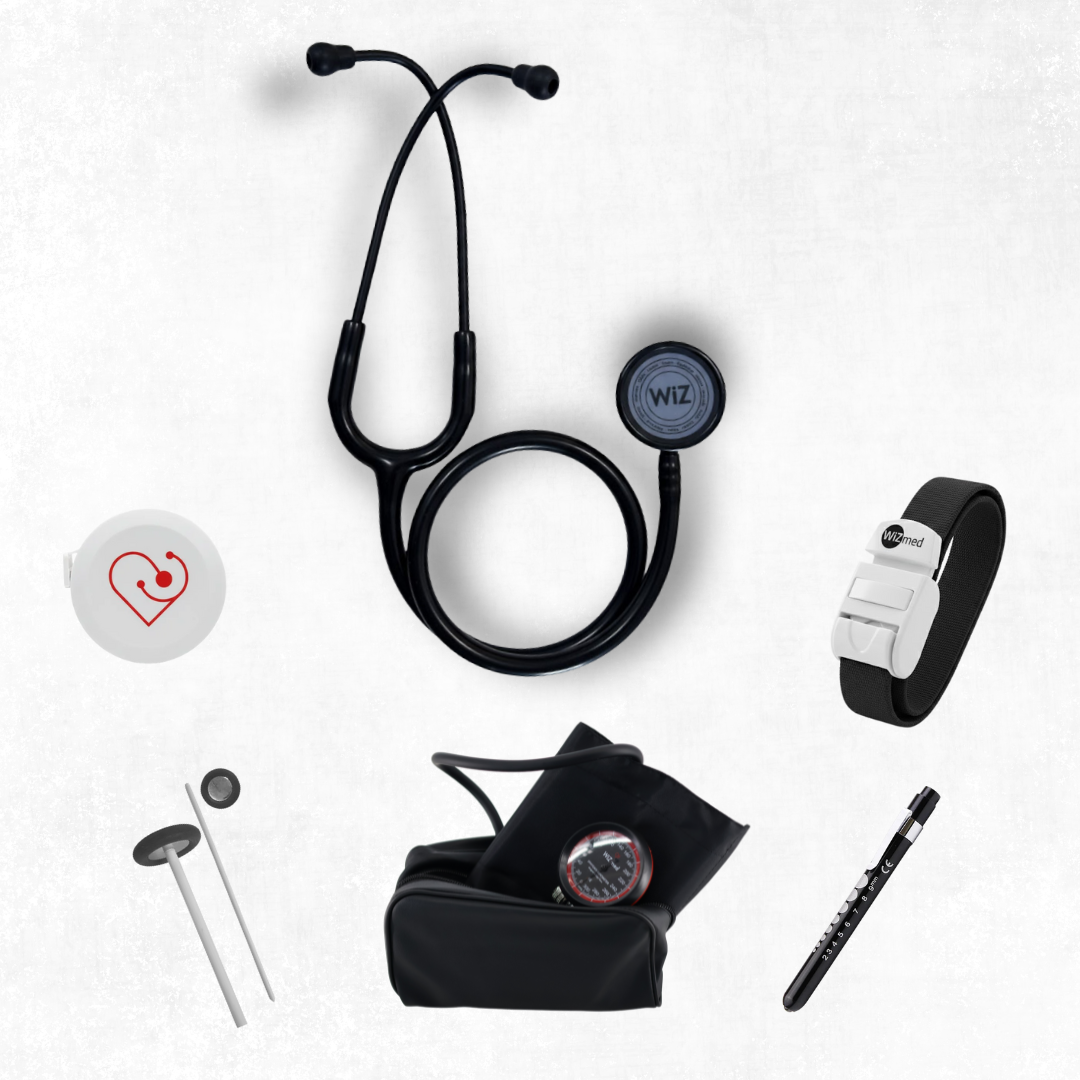
Before your first clinical year you need a small set of examination tools: a stethoscope, a sphygmomanometer, a pupil torch, a patella hammer, 128 Hz and 512 Hz tuning forks, a measuring tape and a tourniquet. The anatomy years before that need a dissection kit; later rotations add an ECG ruler, a suturing kit and, for some, a diagnostic set. Everything else can wait until you know you need it.
The short answer
- Pre-clinical: a dissection kit (some universities also want a fixed-blade scalpel).
- First clinical year: stethoscope, BP set, pupil torch, patella hammer, measuring tape and tourniquet.
- Neuro and ENT: 128 Hz and 512 Hz tuning forks.
- Medicine blocks: an ECG ruler. Surgery: a practice suture kit.
- Check your own faculty's list first: requirements differ between universities.
Your kit, year by year
The checklist
Pre-clinical years: the anatomy lab
A dissection kit, plus a fixed-blade scalpel if your university asks for one.
First clinical year: the examination kit
Stethoscope, sphygmomanometer, pupil torch, patella hammer, measuring tape and tourniquet.
Neuro and ENT examination
A 128 Hz tuning fork for vibration sense and a 512 Hz fork for the Rinne and Weber tests.
Medicine and cardiology blocks
An ECG ruler for rate, intervals and axis.
Surgery and clinical skills
A practice suture kit for knots and closures.
Later clinical years, if required
A diagnostic set for otoscopy and fundoscopy.
Internship and community service
A pocket stamp, a name badge, shears and a pulse oximeter.
| Item | What it is for | When you need it | Price (Oct 2026) |
|---|---|---|---|
| Stethoscope | Heart, lung and bowel sounds; manual blood pressure | First clinical year | R799 to R2,599 for most students |
| Sphygmomanometer | Manual blood pressure | First clinical year | R239 to R1,599 |
| Pupil torch | Pupils, throat, skin | First clinical year | R55 |
| Patella hammer | Reflexes and plantar response | First clinical year | R35 to R129 |
| Tuning forks (128 Hz and 512 Hz) | Vibration sense; Rinne and Weber hearing tests | Neuro and ENT examination | From R259 each |
| Measuring tape | Waist, limb and head circumference, fundal height | First clinical year | R20 to R40 |
| Tourniquet | Blood draws and IV lines | First clinical year | R29 |
| ECG ruler | Rate, intervals and axis on an ECG | Medicine and cardiology blocks | R49 |
| Dissection kit | Anatomy lab | Pre-clinical years | R159 |
| Suture kit | Practising knots and closures | Clinical skills, surgery | R549 to R799 |
| Diagnostic set | Otoscopy and fundoscopy | Later clinical years, if required | R685 to R9,399 for most students |
Pre-clinical years: the anatomy lab
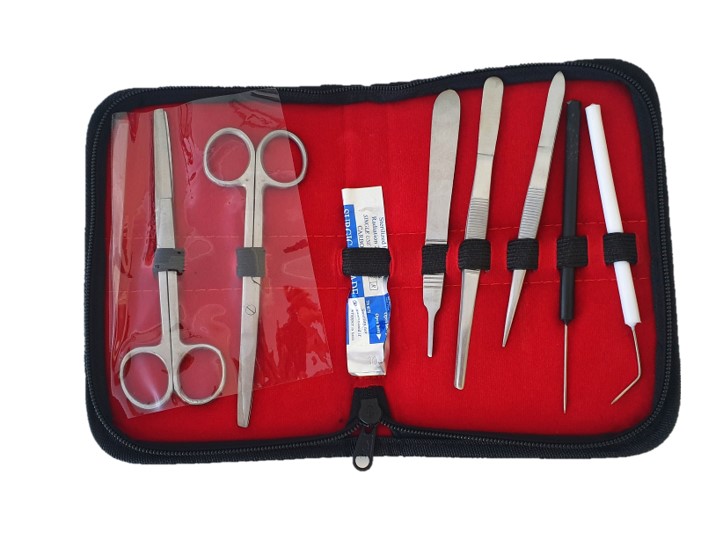
Your first equipment purchase is usually a dissection kit. Our student dissecting kit has sharp and blunt scissors, two tweezers, two probes and a scalpel handle in a case. Some universities ask for more: Wits, for example, requires a fixed-blade scalpel. The First-Year Anatomy Kit adds a pupil torch, Babinsky hammer, tourniquet, measuring tape, BMI tape and the 7-Step ECG ruler, so the basics are in your bag before you need them.
For the anatomy lab


There is more detail in dissection and suturing kits for medical students.
First clinical year: the examination kit
Stethoscope
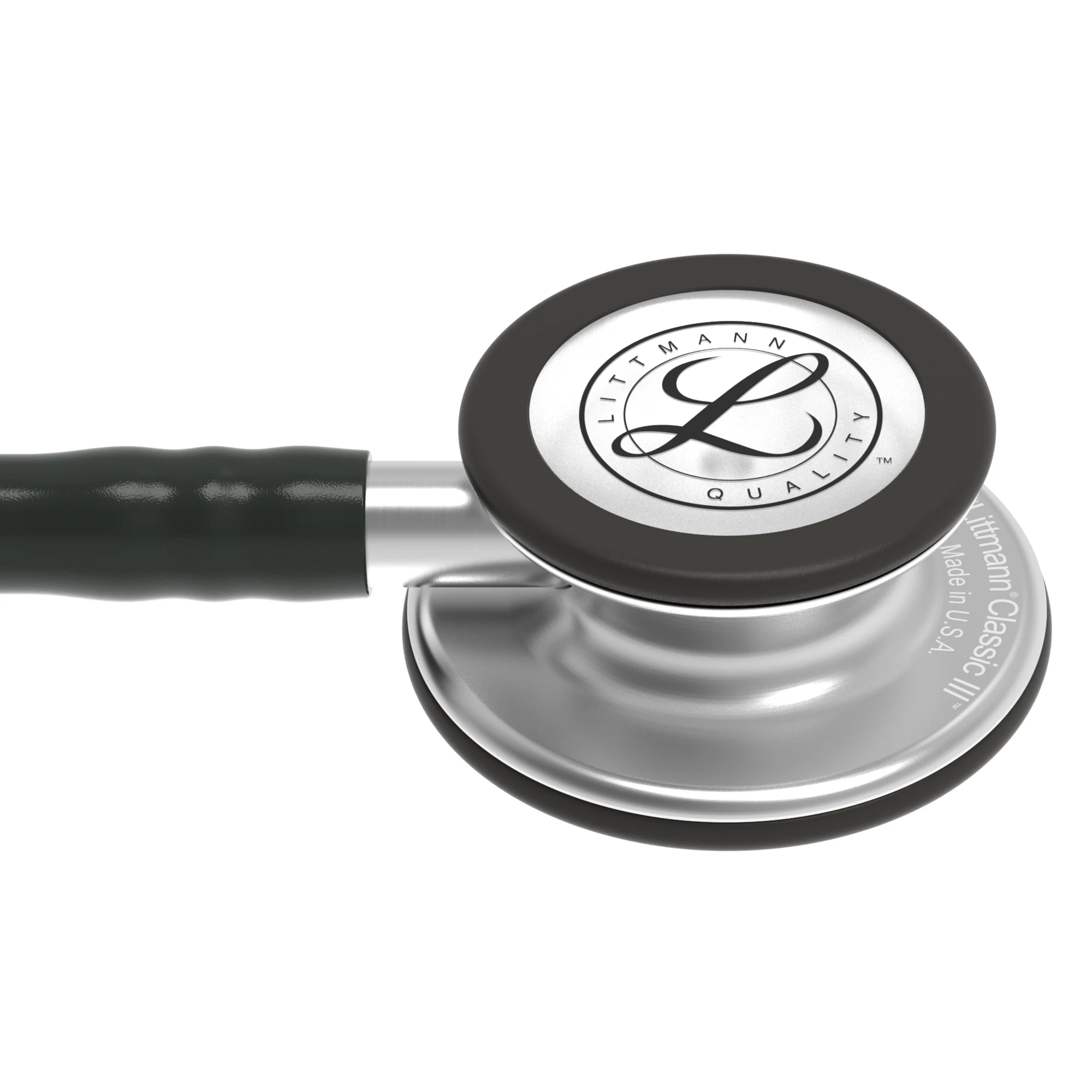
The most expensive item on the list, and the one to get right. You need a dual-head stethoscope with a tunable or adjustable-frequency diaphragm, not a single-head home scope. Most of our medical students choose a Littmann Classic III; on a tighter budget the WiZmed Stethoscope and ADC Adscope 603 do the same job. Our student stethoscope guide compares them by budget and course.
Sphygmomanometer
A manual aneroid set with an adult cuff. The WiZmed Sphygmomanometer has a 0 to 300 mmHg gauge, a 22 to 32 cm adult D-ring cuff, a calibration key and a 2-year warranty. Learn the technique properly; the OSCE will test it, and our blood pressure guide walks through it.
Pupil torch, patella hammer, tape and tourniquet
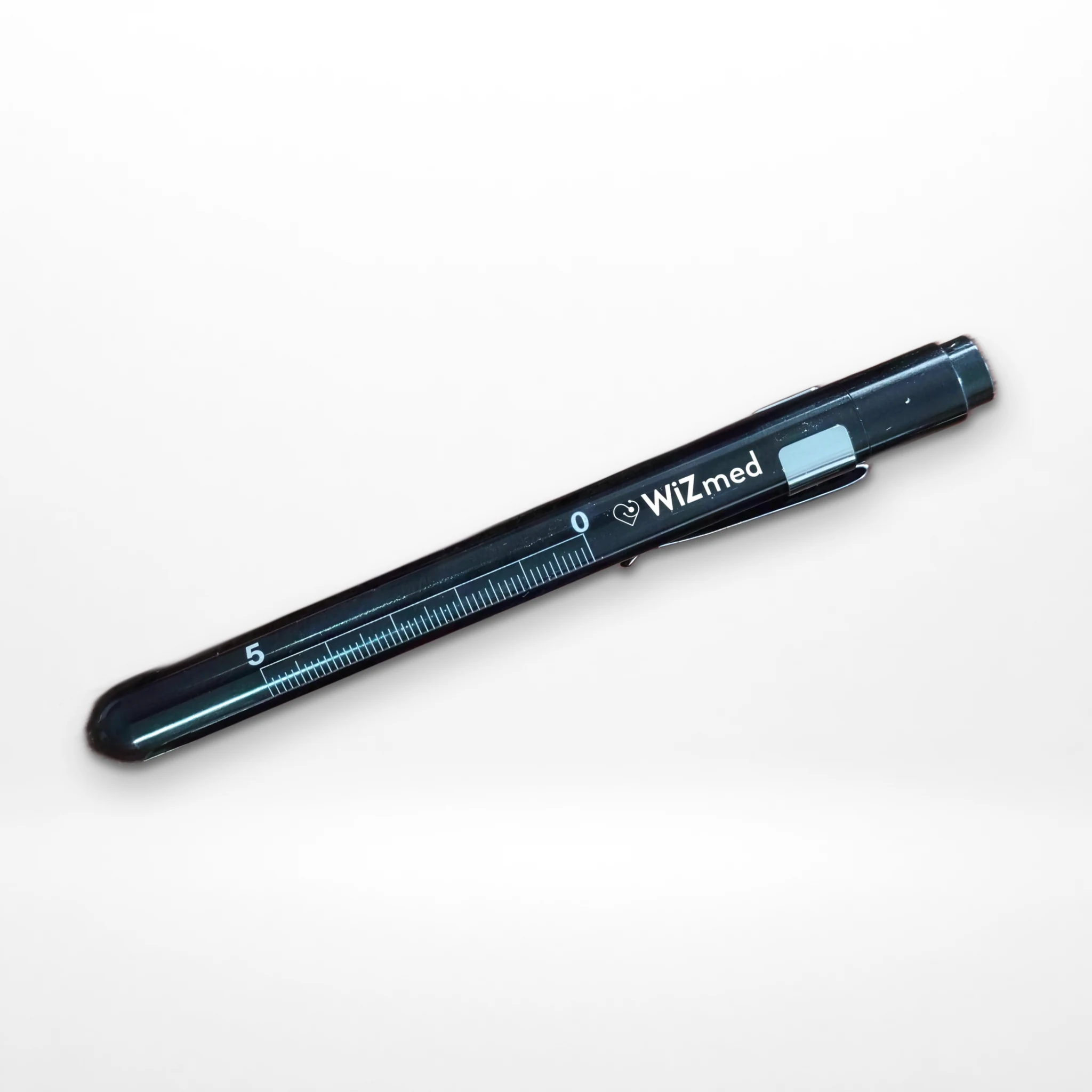
Small, cheap and easy to forget. Our pupil torch has a 0 to 5 cm millimetre ruler on the barrel for pupil size. The adult Babinsky nylon hammer is the usual student choice. A 150 cm retractable measuring tape covers waist and limb measurements, and a circumference tape handles head circumference and fundal height. The tourniquet has a one-handed quick-release buckle.
The small tools



Buying it as a kit
Already own a stethoscope? The Ward Kit, Bring Your Own Stethoscope has the same small tools plus the BP set and the 7-Step ECG ruler. The WiZmed Student Combo is just the pupil torch, adult nylon patella hammer, 150 cm measuring tape and a tourniquet.
Other ways to buy the kit

CNS and ENT examination kit
The neurological examination needs a hammer for reflexes, a 128 Hz tuning fork for vibration sense, a torch for the pupils and something for sensation. The ENT examination adds a 512 Hz tuning fork for the Rinne and Weber tests. If you want sensory testing tools on the hammer itself, the Buck hammer has a built-in brush and needle. Why you need two forks is explained in 128 Hz vs 512 Hz tuning forks.
Medicine and surgery blocks
Medicine and cardiology: the ECG ruler
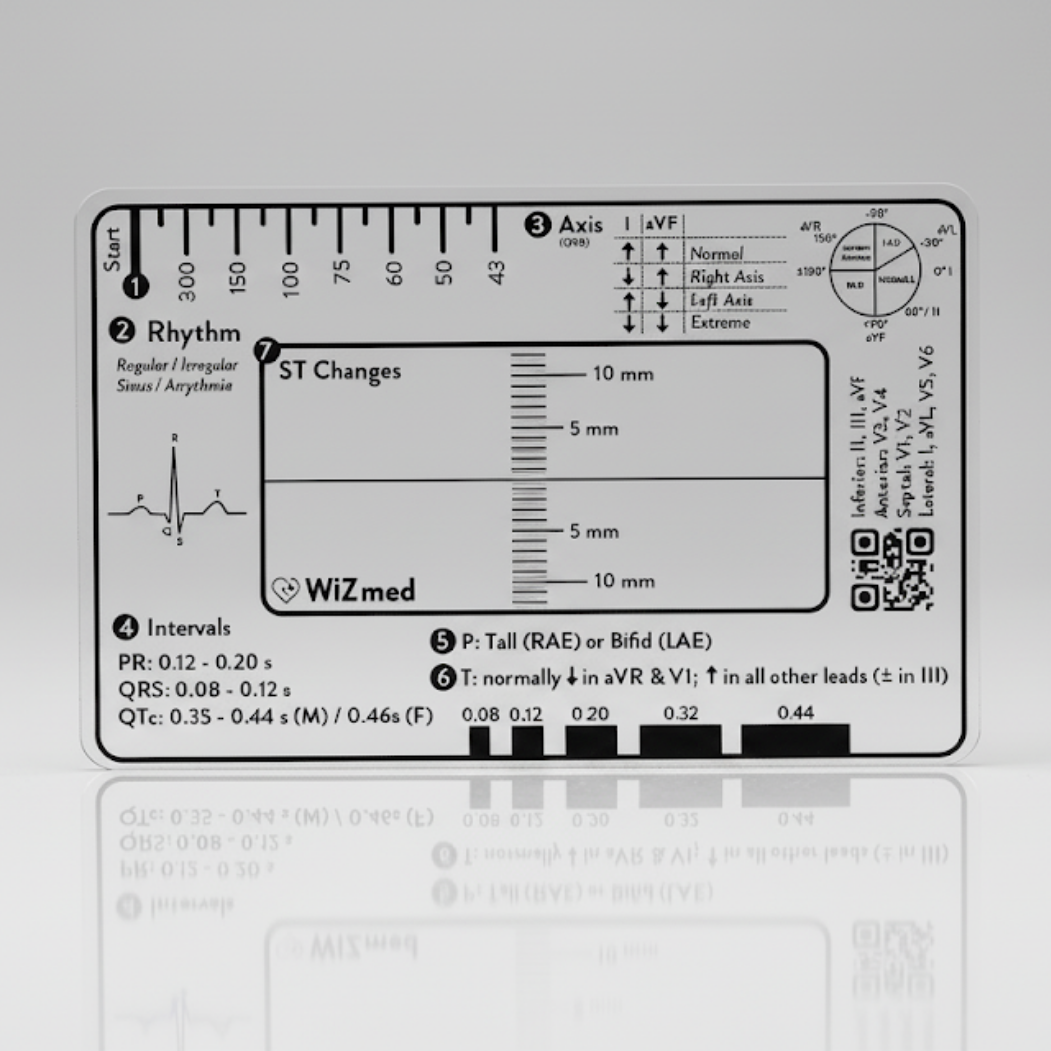
The WiZmed 7-Step ECG Ruler is a pocket card with a rate scale, rhythm checklist, axis quadrant, interval ranges and an ST-segment millimetre box, calibrated for 25 mm/s and 10 mm/mV. Studying in a group? There is an ECG ruler 3-pack.
Surgery and clinical skills: suturing
The WiZmed Premium Suture Kit has a needle holder, Adson and mosquito forceps, iris scissors, a scalpel handle, a silicone wound pad and practice sutures. The Future Surgeon bundle adds a 3D abdominal practice pad and a fixed-blade scalpel. Neither is sterile; they are for practice, not patients.
Suture practice


Beyond the examination kit
Diagnostic set: only if your rotations need one
An otoscope and ophthalmoscope are the priciest items after the stethoscope, so check whether your rotations require your own before you buy. Options run from the WiZmed otoscope (with an optional basic ophthalmoscope head) and the Arclight pocket ophthalmoscope-otoscope, through the Welch Allyn Pocket Junior otoscope and Pocket LED set, to the full-size Welch Allyn Professional Plus diagnostic sets.
Otoscopes and diagnostic sets

Otoscopes and Ophthalmoscopes
WiZmed Diagnostics Equipment - Otoscope (with Optional Ophthalmoscope Add-on Kit)
2 colours


Scrubs, a case and a book
If your rotations call for scrubs, WiZ Scrubs Basic 2.0 and Comfort 2.0 sets are made in South Africa; our scrubs size guide helps you pick a size. A WiZpod hard case protects a single-lumen stethoscope in your bag, and the Oxford Handbook of Clinical Medicine, 11th edition, is the pocket guide for the wards and on call.
For the bag


Textbooks
Oxford Handbook of Clinical Medicine, 11th Edition (New Latest 2025 Edition)
Internship and community service
By internship you will already own the examination kit. What changes is the admin and the procedures.
Nursing, physio and paramedic students
The core is the same: stethoscope, BP set, torch, tape and tourniquet. Physiotherapy students add goniometers and a 128 Hz fork; the Physio & Rehab Assessment Kit has 12-inch and 8-inch goniometers, a 128 Hz tuning fork, a Babinsky hammer, the Tape PRO and a BMI tape. Paramedic students usually want EMT shears as well.
For physio and paramedic students


Questions people ask
What tools or equipment will I use as a doctor?
Every day: a stethoscope, a blood pressure set, a pen torch, a patella hammer, tuning forks, a measuring tape and an ECG ruler or calliper. In some settings you will also use an otoscope and ophthalmoscope. As an intern, add a pocket stamp, a name badge and shears.
What is in a CNS examination kit?
A patella hammer for reflexes, a 128 Hz tuning fork for vibration sense, a pupil torch and something for testing sensation. Add a 512 Hz fork if the kit also covers the Rinne and Weber hearing tests.
Do medical students need their own diagnostic set?
It depends on your university and rotations, so check your course list first. A diagnostic set is the most expensive item after the stethoscope, ranging from R685 for an entry-level otoscope to over R8,000 for a full Welch Allyn set (October 2026).
What measuring tape do medical students need?
A retractable 150 cm tape with centimetre and inch scales covers waist, hip and limb measurements. A circumference tape is handy for head circumference and fundal height.
Is there a kit with everything for first clinical year?
The WiZmed Stethoscope Combo includes the WiZmed Stethoscope, a sphygmomanometer, tourniquet, patella hammer, measuring tape and pupil torch. If you already have a stethoscope, the Ward Kit covers the rest plus an ECG ruler.

Written by
Ashraf Moosa