A dissecting kit is the set of scissors, tweezers, probes and a scalpel handle you use in anatomy practicals, and most South African medical and health sciences students need one from first or second year. A suture practice kit is different: a needle holder, tissue forceps, scissors and a silicone pad for learning to stitch at home before skills labs and OSCEs. Both are training tools, not sterile, and never for use on patients.
The short answer
- Anatomy practicals: a dissecting kit, and whatever extra your course list names.
- Starting first year: the First-Year Anatomy Kit adds the pocket tools to the dissecting kit.
- Learning to stitch: a suture kit with a needle holder, toothed forceps, scissors and a mesh-backed pad.
- Preparing for OSCEs and surgery: the Future Surgeon bundle adds a 3D abdominal pad.
- None of these instruments are sterile. They are for specimens and practice pads only.
What is in a dissecting kit?
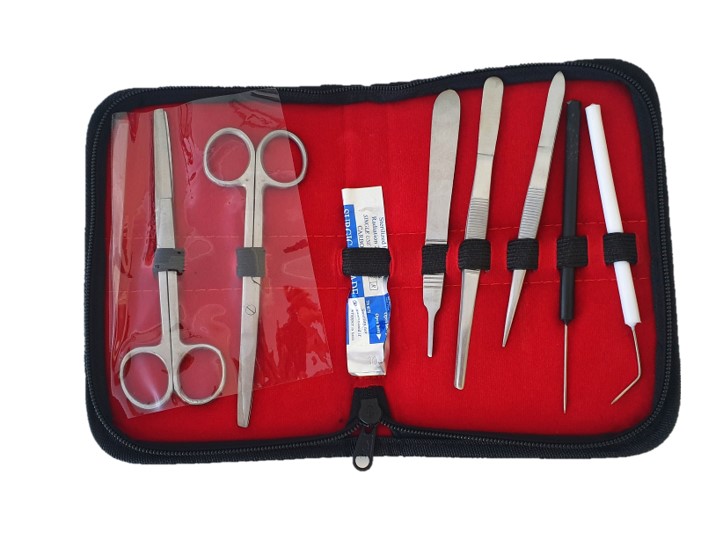
A dissecting kit holds the hand instruments for taking apart a preserved specimen in the anatomy lab. The WiZmed Premium Student Dissecting Kit contains:
- Sharp scissors and blunt scissors
- Fine-point and standard-point tweezers, both 12 cm
- A blunt probe and a sharp probe
- A scalpel handle with a blade
- A red leatherette case that closes to keep everything together
In the lab, the scalpel makes the skin incisions. Most of the real work is blunt dissection: separating fascia and fat along natural planes with the blunt probe, blunt scissors or closed tweezers, so you expose nerves and vessels without cutting them. The sharp probe and fine tweezers are for small structures.
Which dissecting kit do you need?
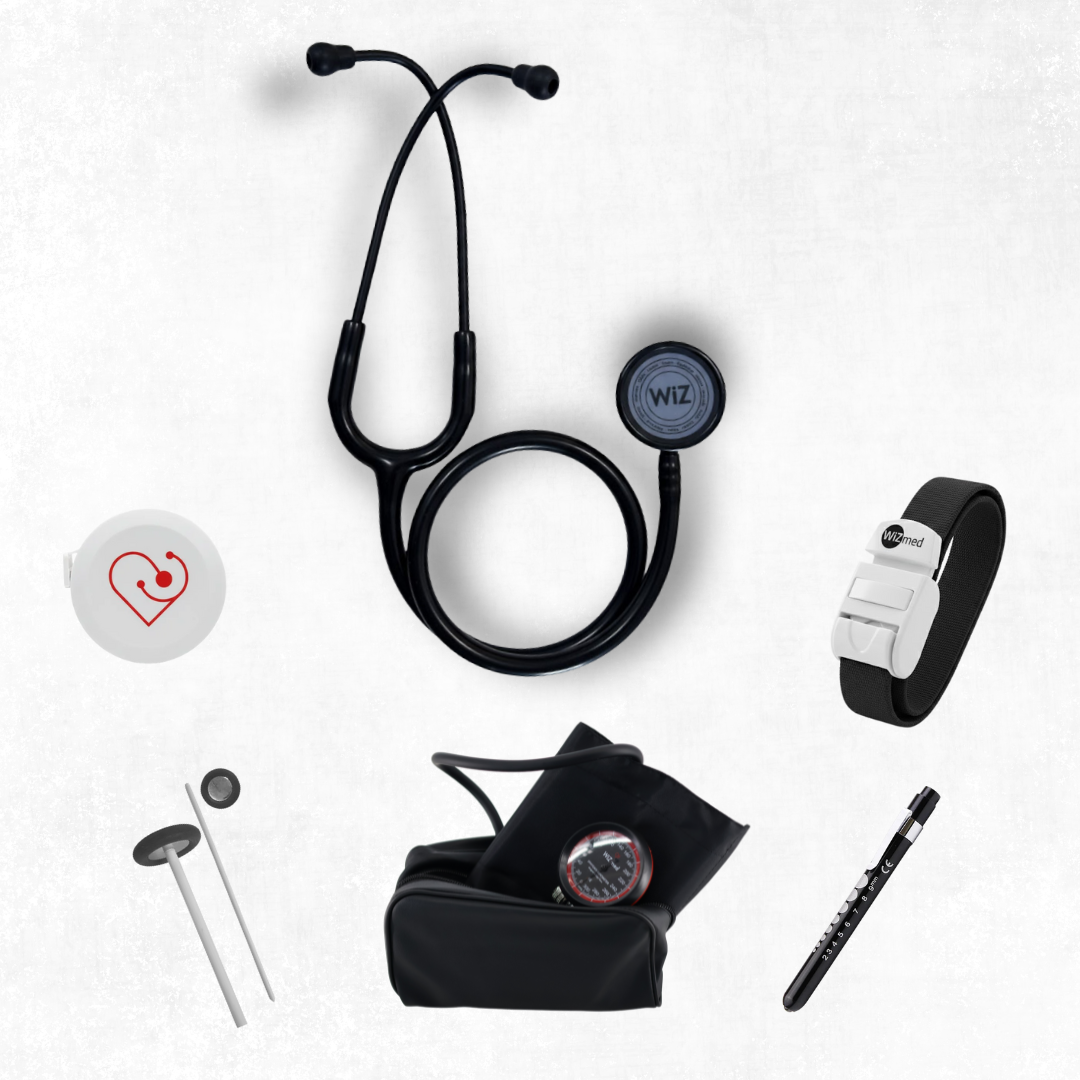
If you are starting first year, the First-Year Anatomy Kit puts the dissecting kit together with a pupil torch, Babinsky hammer, tourniquet, measuring tape, BMI tape and the 7-Step ECG ruler. For second-year anatomy, the Anatomy Pro Pack adds a polycotton doctor's jacket for the dissection hall and a free Anatomy WiZpin; the jackets are made to order, so order well before your first practical.
Dissecting kits compared
 Entry-level Premium Dissecting KitR159 | For first years First-Year Anatomy KitR329 |  Asked for by Wits Fixed Blade ScalpelR55 | |
|---|---|---|---|
| What you get | Scissors, two tweezers, two probes, scalpel handle and blade | The dissecting kit plus pupil torch, Babinsky hammer, tourniquet, tapes and ECG ruler | One-piece stainless steel scalpel |
| Size | 12 cm tweezers | As the kit, plus pocket tools | 15.5 cm long, 3.7 cm blade |
| Case | Red leatherette, closes | Includes the kit's case | None |
| Best for | Anatomy practicals | Anatomy plus your first clinical skills | Courses that list a fixed-blade scalpel |
| Sterile | No | No | No |
Our verdict
Buy the dissecting kit for anatomy, the First-Year Anatomy Kit if you also need the pocket tools, and add a fixed-blade scalpel only if your course asks for one.
Some students add rat tooth forceps, which have interdigitating teeth that grip skin and dense tissue without slipping. They damage delicate tissue, so keep them for skin and tough layers, not fine work.
Dissecting kits and extras


What is in a suture practice kit?
A suture practice kit lets you learn the hand movements before you ever close a wound in a skills lab or casualty. The WiZmed Premium Suture Kit contains:
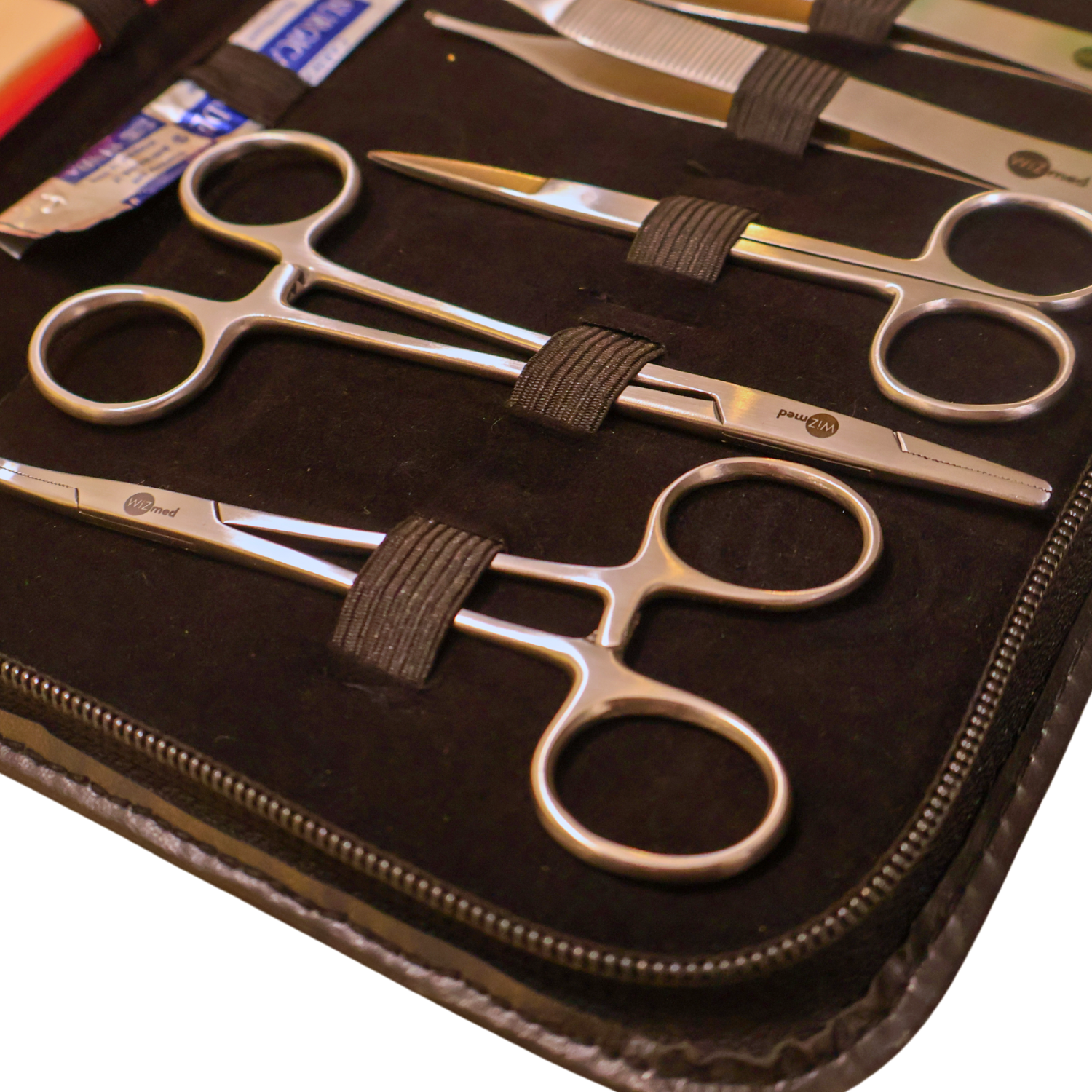
- Mayo-Hegar needle holder, 14 cm
- Adson tissue forceps, plain, and Adson tissue forceps with 1×2 teeth, both 12.5 cm
- Halsted mosquito forceps, curved, 12.5 cm
- Iris scissors, pointed and straight, 12 cm
- No. 3 scalpel handle with a No. 10 blade
- A mesh-reinforced silicone pad with pre-cut wounds
- Practice sutures in assorted sizes and needles
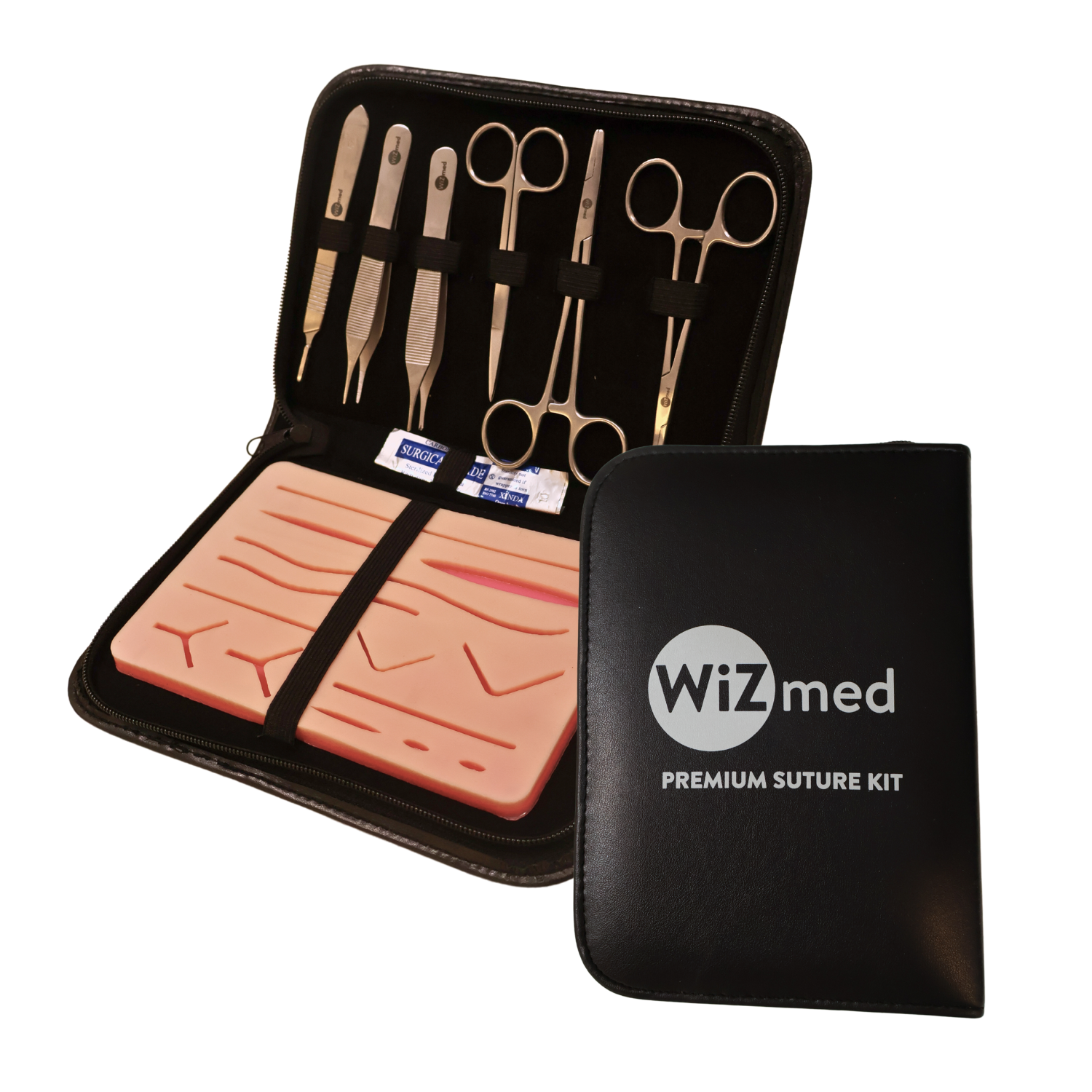
The practice sutures are expired CliniSut sutures, marked for simulation use and included for practice and demonstration only. The instruments are stainless steel, and the kit suits medical and nursing students.
Which suture kit should you buy?
Suture kit or Future Surgeon bundle?
Start here Premium Suture KitR549 | 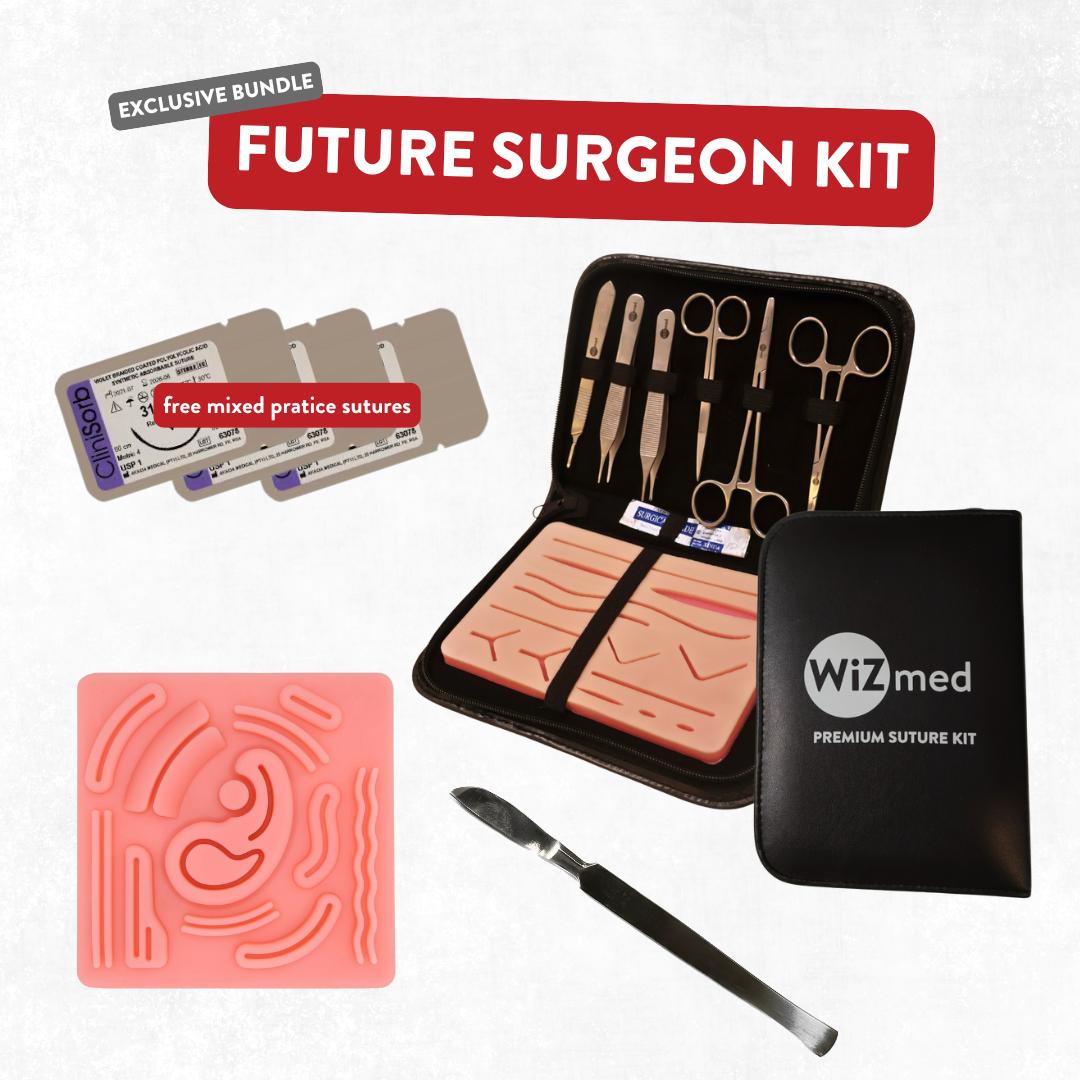 For OSCEs and rotations Future Surgeon bundleR799 | |
|---|---|---|
| Instruments | Needle holder, three forceps, iris scissors, scalpel handle | The full Premium Suture Kit, plus a fixed-blade scalpel |
| Practice pad | Mesh-reinforced silicone pad with pre-cut wounds | The kit's pad plus the WiZSuture 3D abdominal pad |
| Sutures | Practice sutures in assorted sizes | At least three mixed practice sutures, plus the kit's |
| Best for | Learning basic stitches and knots at home | Deeper wounds and different angles before skills labs and surgery |
Our verdict
The suture kit covers the basics. Choose the bundle if you want the 3D pad for deeper layers, which is otherwise out of stock on its own.
Many students buy both a dissecting kit and a suture kit. They overlap only in the scalpel handle; the needle holder and toothed forceps in the suture kit are what you need for stitching.
Suture practice pads
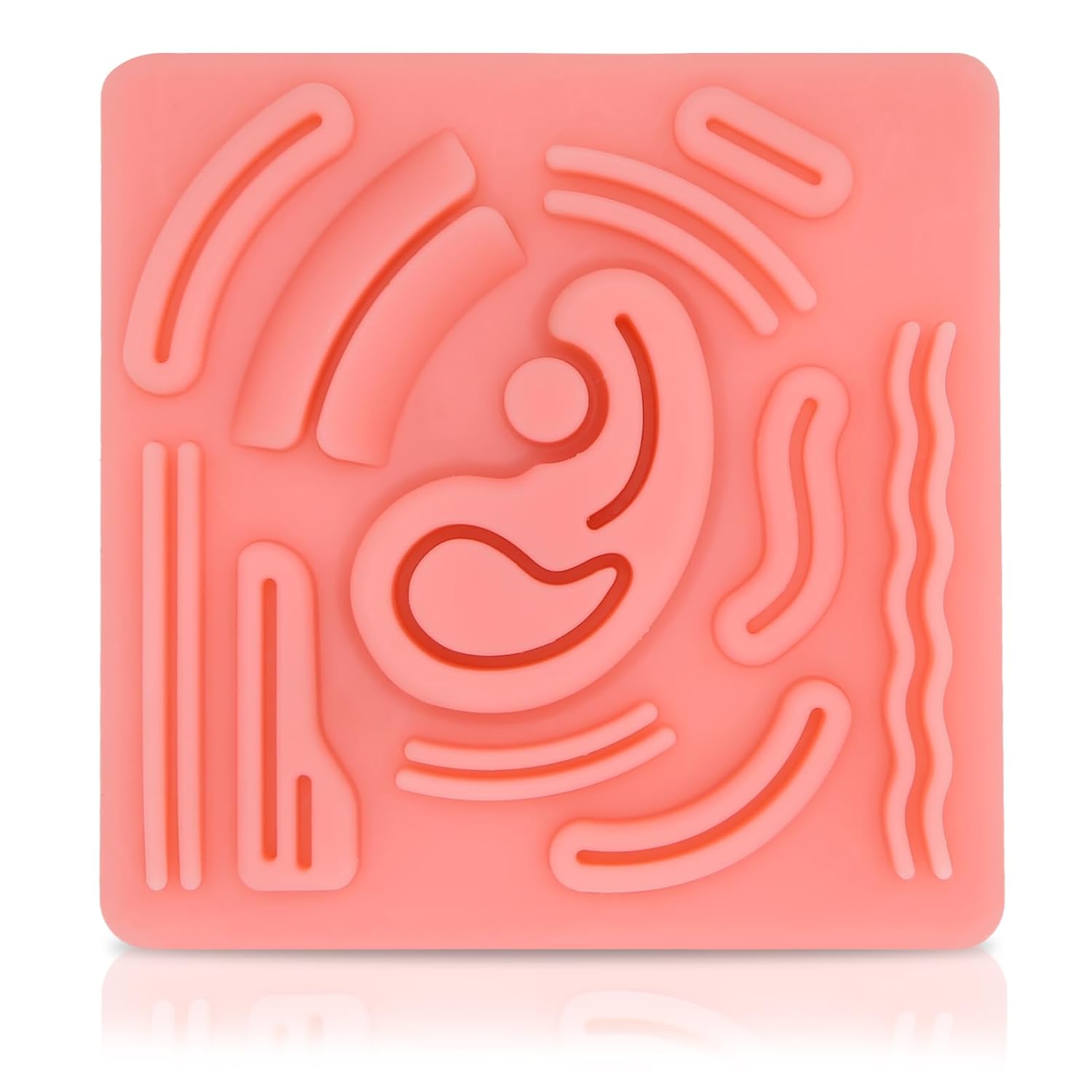
The pad matters as much as the instruments. The pad in the suture kit has a mesh layer under the surface, so beginners are less likely to tear sutures through. A replacement practice pad fits the kit once yours is worn out. The WiZSuture 3D abdominal pad is reusable silicone shaped like an abdominal wall, with raised and curved wounds for practising at different depths and angles. Both pads are out of stock on their own at the time of writing; the 3D pad comes in the Future Surgeon bundle.
How to practise suturing at home
A practice routine for beginners
Simple interrupted first
Repeat simple interrupted sutures until each one looks the same.
Load the needle
Hold the needle in the needle holder about two-thirds of the way back from the point.
Follow the curve
Enter the skin at right angles and follow the curve of the needle with a turn of your wrist, rather than pushing straight through.
Equal bites
Take equal bites on each side so the edges meet and turn slightly outwards.
Instrument ties
Practise instrument ties with the needle holder until your square knots are quick and flat.
Move on
Then try continuous and mattress sutures, and use the 3D pad for deeper layers.
Real sutures: what the Clini range teaches you
Once you know the basic stitches, it helps to understand the materials used on real patients. Sutures are absorbable or non-absorbable, and braided or monofilament. The USP size tells you thickness: the more zeros, the finer the thread, so 6/0 is finer than 2/0. Our Clini range, such as CliniSorb and CliniLon, covers the main types. These are clinical sutures, not practice materials, and they are all out of stock at the time of writing.
| Suture | Type | From the product page |
|---|---|---|
| CliniGut Plain | Absorbable catgut | Strength held 7 to 10 days, absorbed in about 90 days |
| CliniSorb | Absorbable, braided (Polyglactin 910) | 50% strength at 21 days, absorbed in 56 to 70 days |
| CliniSolv | Absorbable PDO monofilament | Wound support up to 6 weeks |
| CliniLon | Non-absorbable nylon monofilament | For skin closure, low tissue reaction |
| CliniSilk | Non-absorbable braided silk | Silicone-coated, soft handling and secure knots |
| CliniLene | Non-absorbable polypropylene monofilament | Smooth and inert; cardiovascular, hernia and skin closure |
Safety and the rest of your kit
The dissecting kit is the entry-level purchase and the Future Surgeon bundle is the most complete; the cards above show current prices. For everything else on your list, see our medical student equipment list and our guide to the best stethoscope for medical students.
Questions people ask
What is in a student dissecting kit?
The WiZmed Premium Student Dissecting Kit has sharp and blunt scissors, fine-point and standard-point 12 cm tweezers, a blunt and a sharp probe, and a scalpel handle with a blade, in a red leatherette case. It is not sterile and is for non-living specimens only.
Do medical students need a suturing kit?
Most students learn suturing in skills labs, and practising at home beforehand helps. A suture kit with a needle holder, toothed forceps, scissors and a silicone pad lets you repeat the basic stitches and knots until they are second nature before an OSCE or rotation.
Which suture practice kit is best for beginners?
Start with a kit that has a needle holder, toothed forceps, scissors and a pad with a mesh layer, so you are less likely to pull sutures through. The WiZmed Premium Suture Kit has all of these; the Future Surgeon bundle adds a 3D abdominal pad for deeper wounds.
Which dissecting kit does Wits ask for?
Wits medical students are asked for a fixed blade scalpel, a one-piece stainless steel scalpel, 15.5 cm long with a 3.7 cm blade. Check your own course's equipment list, because requirements differ between universities.
Can I use a dissecting or suture practice kit on patients?
No. These kits are not sterile and are for training only: anatomy specimens and practice pads. Clinical procedures need sterile instruments and sutures from your hospital or clinic.
Are the sutures in the practice kit real?
They are real CliniSut sutures that have expired and are marked for simulation use. They handle like clinical sutures, which makes them good for practice, but they are for practice and demonstration only.

Written by
Ashraf Moosa